The Basics of this Burgess Bird
A Loggerhead Shrike is a species of bird that many have probably never heard of before. I can say that was true for me before reading Thornton W. Burgess’ classic, The Burgess Bird Book for Children. They are a really incredible bird to learn more about. Since our first round of reading the classic, I have been able to identify a Loggerhead Shrike in the field especially because the behavior below is such an identifier of this Burgess bird.
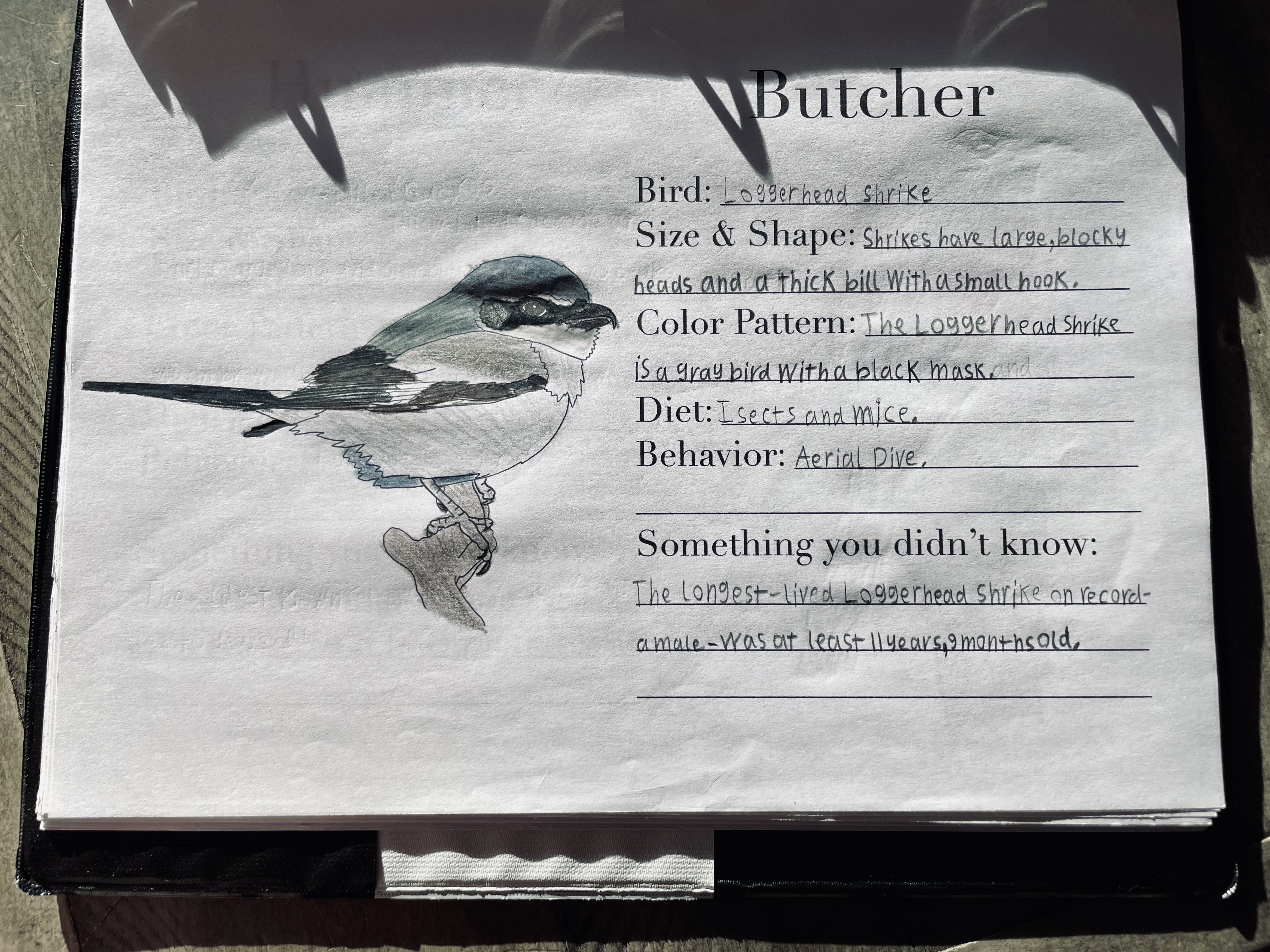
In appearance, this Burgess bird wears a black mask around its eyes. They are small and stocky, about the size of a Robin. Their heads look strong, no wonder they are called a Loggerhead Shrike and the end of their bill has a hook.
Why does this Burgess bird have a hook on it’s bill?
When Peter Rabbit meets Butcher for the first time, he has just happened upon Butcher’s storehouse. It was in a thorn tree that Peter saw different insects fixed on the sharp thorns: grasshoppers, a moth, caterpillars. Not only were there insects, but Butcher had also placed a lizard, a small mouse, and a baby bird. This makes Peter remark:
“But I don’t understand yet why he fastens his victims on those long thorns,” said Peter.
“For two reasons,” replied Skimmer. “When he catches more grasshoppers and other insects than he can eat, he sticks them on those thorns so that later he may be sure of a good meal if it happens there are no more to be caught when he is hungry. Mice, Sparrows, and things too big for him to swallow he sticks on the thorns so that he can pull them to pieces easier. You see his feet and claws are not big and stout enough to hold his victims while he tears them to pieces with his hooked bill. Sometimes, instead of sticking them on thorns, he sticks them on the barbed wire of a fence and sometimes he wedges them into the fork of two branches.”
Burgess, Thornton W., The Burgess Bird Book for Children, Living Press Books, 2021, p.179-180.
This Burgess Bird has an Amazing Aerial Dive
The other striking behavior of the Loggerhead Shrike is that it loves to complete an aerial dive when catching its prey. He is the type of bird that can sit up high and scan the perimeter, looking for insects, lizards, and mice. Patience is imperative besides his keen eyesight. Once he sees his prey, he can be precise in his flight and aerial dive in order to catch it! It must be a satisfying activity for Butcher. It is certainly amazing to watch!
What we gathered for this Burgess Bird
Through our reading of the book and a look over at Cornell Lab’s allaboutbirds.org, we gathered this about Butcher:

Until next time, keep on the lookout for birds who love to save some food for later! <3 Kate
For more you can look at The Burgess Bird Writing and Coloring Pages and The Burgess Birds in Detail.
The Living Book Press link above contains an affiliate link, so I may receive a small payment if you make a purchase, at no additional cost to you.